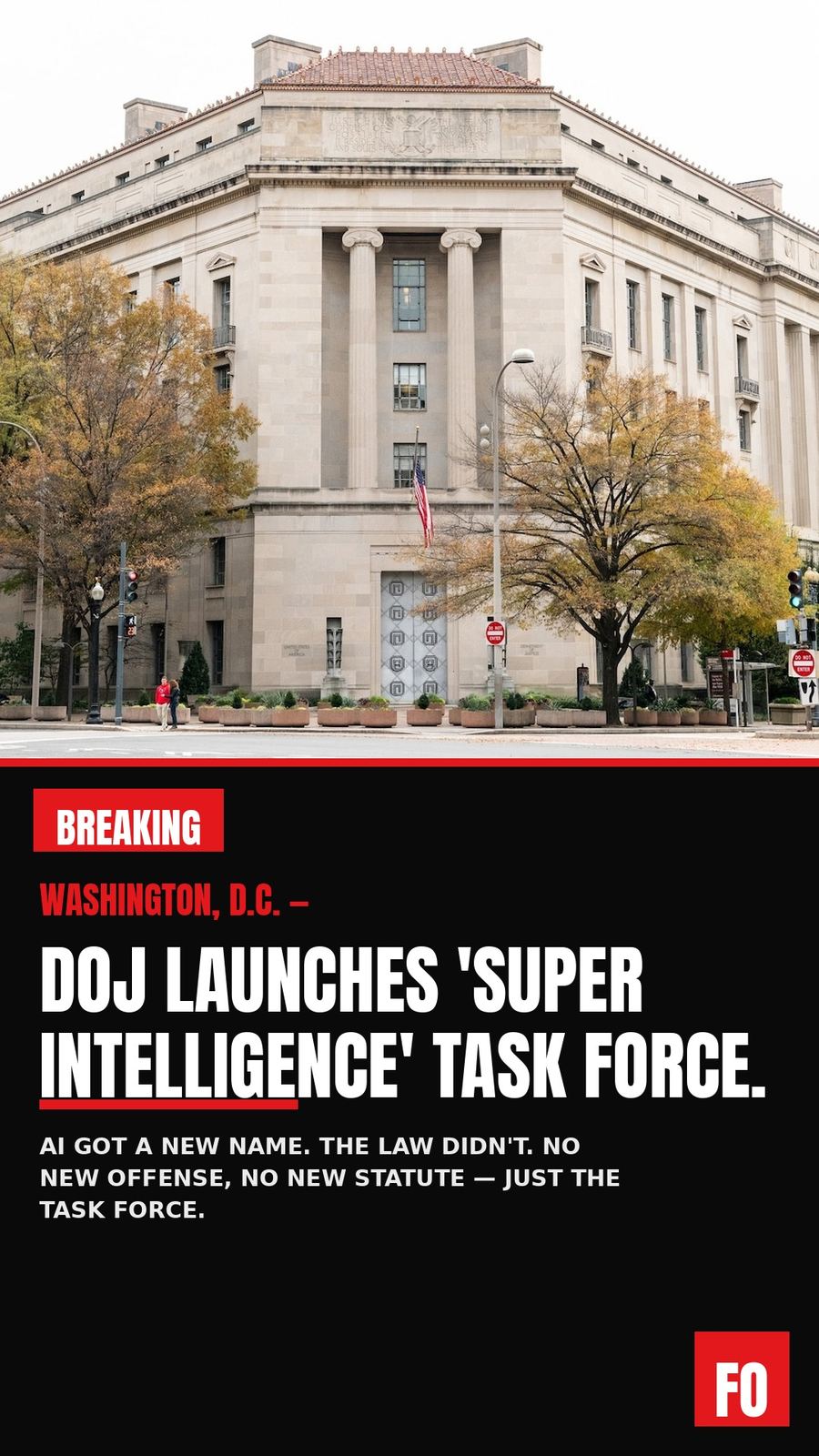
The Department of Justice has a new task force, and it has a new name for the thing it polices.
The Super Intelligence Task Force, announced November 5, will coordinate the department's enforcement against misuse of advanced AI by foreign states, criminal organizations and fraudsters. It is co-chaired by Associate Attorney General Stanley Woodward and Associate Deputy Attorney General Stephen Weiss, and it will serve as the department's main point of contact with the White House's Super Intelligence Force. The mission is serious. The vocabulary is brand new.
That is because "super intelligence" is the executive branch's new term for artificial intelligence, adopted under an executive order signed September 29 that directs agencies to use it in place of "AI" wherever the law allows. The technology did not change. The acronym did. Somewhere in Washington, a find-and-replace ran across the entire federal government, and a task force was born.
Read the announcement closely and a second detail stands out: it names no new offense and no new statute. The task force will prosecute people whose use of the technology violates existing law — fraud, hacking, sanctions evasion, the usual catalog. The crimes are the old ones. Only the letterhead is new.
Like your satire sourced?
Get the Dispatch — the week's sharpest offenses, with receipts attached.
None of this is to say the work doesn't matter. AI-driven fraud is real, and foreign actors misusing the technology is a genuine enforcement problem. It is only to say that the government's first move against super intelligence was to rename it — and its second was to form a committee about the rename. The robots have been warned. They have not, as far as anyone can tell, been charged.
The underlying reporting is filed in the Evidence Locker: U.S. Department of Justice (Nov. 5, 2026).