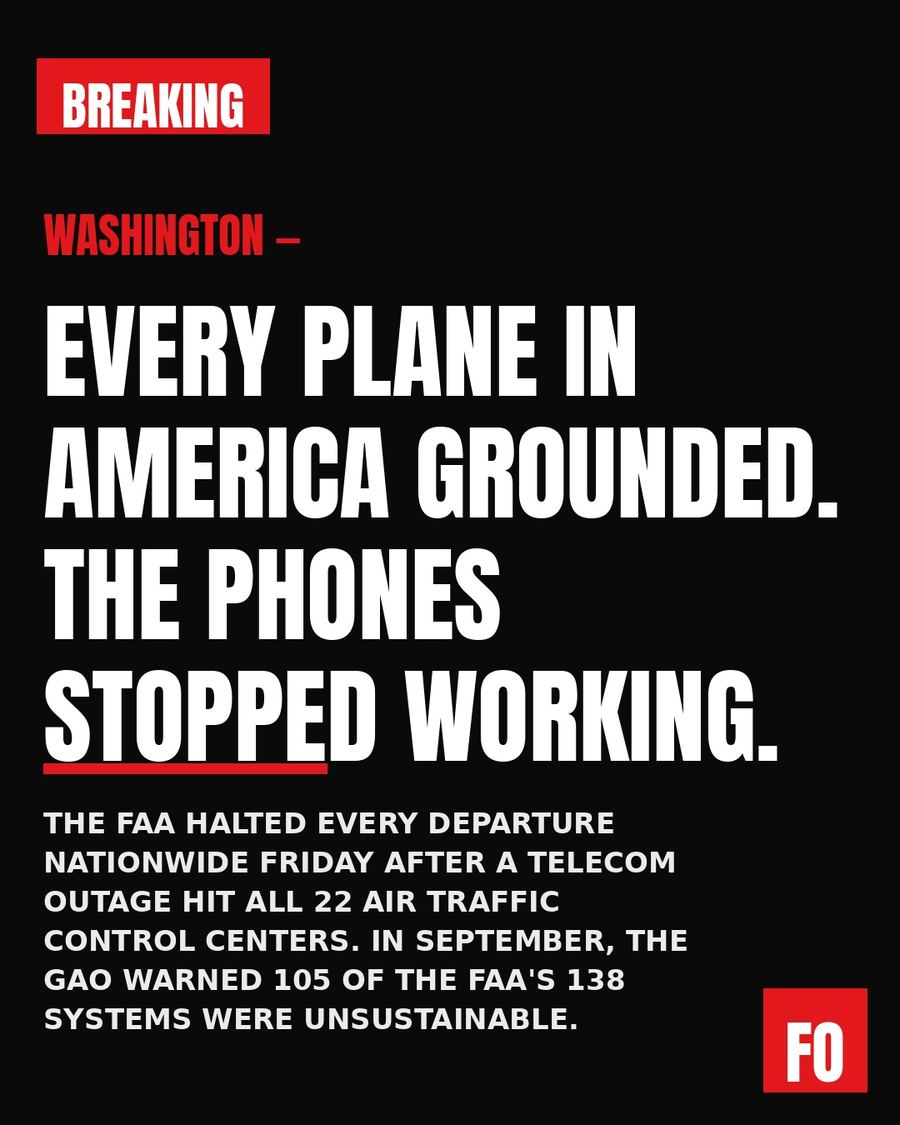
On Friday afternoon, the Federal Aviation Administration grounded every departing flight in America.
The order came from the FAA's Air Traffic Control System Command Center at 3:54 p.m. ET, "due to extraordinary circumstances and for reasons of safety." All departing traffic was to remain on the ground until further notice. Planes already in the air were allowed to keep flying and land. Inbound international flights were handled case by case. The trouble appears to have started around 3:30 p.m. at the Kansas City Air Route Traffic Control Center, where equipment outages were reported, before spreading to the other centers. About 3,100 aircraft were airborne when the stop began. By Friday evening, more than 10,000 flights had been delayed and over 3,000 canceled.
Transportation Secretary Sean Duffy posted at 4:16 p.m. that the stop followed "a communication issue impacting all Air Route Traffic Control Centers," and that FAA technicians were investigating. Just after 5 p.m., the FAA posted that all flights had been halted out of an abundance of caution amid "a temporary telecommunications outage" and that every flight had been accounted for.
Within minutes, the internet had its theories. Officials did not. Homeland Security Secretary Markwayne Mullin told reporters there was "no prior indication as of yet that this was [a] nefarious attack against us," calling it "just a telecommunication outage as of right now." Two law-enforcement officials told CNN that early indications were not a cyberattack — though Mullin added that officials were not ruling anything out yet. He also warned that getting flights back to normal would take "some time," not within the hour.
Like your satire sourced?
Get the Dispatch — the week's sharpest offenses, with receipts attached.
It was the first nationwide ground stop since January 11, 2023, when the FAA halted departures for about two hours after its NOTAM pilot-notification system failed — an outage later traced to contractors accidentally deleting a file.
The deeper story was already on the record. In September 2026, the Government Accountability Office reported that 51 of the FAA's 138 air traffic control systems were unsustainable and another 54 were potentially unsustainable — more than three-quarters of the systems controllers rely on to manage up to 45,000 flights a day. As of May 2026, the FAA had replaced 2,560 of 5,170 old copper telecom lines with fiber. Congress appropriated $12.5 billion in July 2025 for the Brand New Air Traffic Control System, with phase one targeted for completion by December 2028 — but the GAO found the agency still had no reliable lifecycle cost estimate and no integrated master schedule. On Friday itself, the FAA and the White House asked lawmakers for another $30.1 billion. The spring had already previewed the failure: antiquated copper telecom lines at the Philadelphia facility that manages Newark's airspace failed repeatedly in April and May 2025, knocking out radar and radio contact with aircraft.
The stop was lifted at about 8:15 p.m. ET, after roughly four and a half hours. At a White House briefing that evening, Duffy blamed a legacy network failure: the FAA's analog telecom switches and routers had been overloaded with data as new equipment and patches were being installed, producing inconsistent data, intermittent communications and intermittent radar — so the agency shut the system down. He said the FAA had deployed fixes to bring the networks back online, and asked Congress for $50 billion for system upgrades. Mullin reiterated there was no evidence of a cyberattack or any connection to the SMART system or Thursday's Microsoft outage. Delays and cancellations were expected to ripple into the weekend while planes and crews got back where they belonged.
The system didn't break on Friday. It introduced itself.
Sources for the facts behind the joke are in the Evidence Locker entry for this post.