For ten years, the Russia story had a fixed address. It lived in campaign headquarters, in tweets, in dossiers, in cable-news graphics with red arrows pointing at podiums. Every election cycle brought a fresh round of headlines about who might have talked to whom, and every round ended the same way: with a panel discussion.
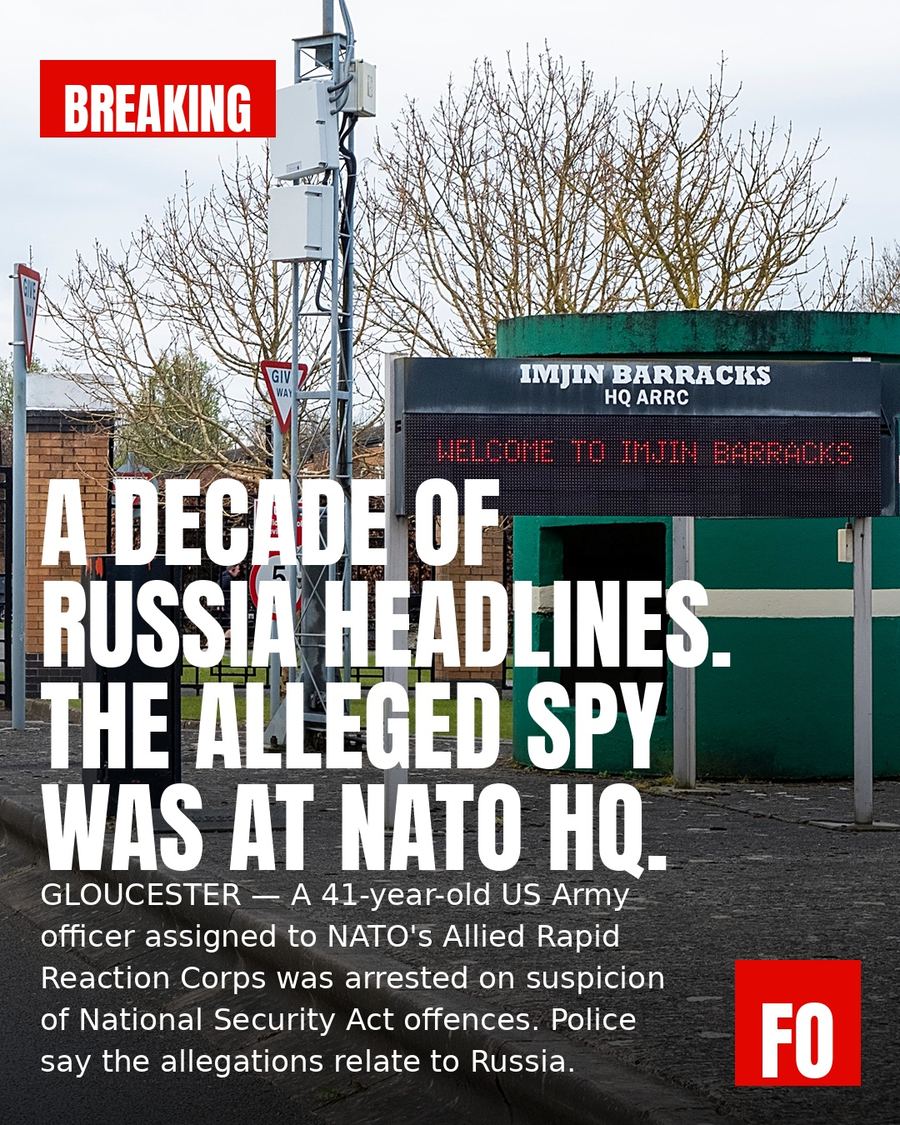
On Tuesday, British counterterrorism police arrested a 41-year-old senior US Army officer near Gloucester on suspicion of offences under the UK's National Security Act 2023: obtaining or disclosing protected information, and assisting a foreign intelligence service. Police say the country the allegations relate to is Russia. The officer, assigned to NATO's Allied Rapid Reaction Corps, remains in custody at a London police station. Searches are under way at two locations in Gloucestershire.
To be clear about what this is and what it is not: this is an arrest on suspicion. The man has not been named. No charges have been announced. An arrest is not a finding of guilt, and nothing has been established about his motive, his politics, or what, if anything, he is alleged to have passed on. FBI Director Kash Patel called the allegations of espionage "of the utmost concern to the United States and our allies," and the Army's counterintelligence chief called the alleged conduct of a senior soldier entrusted with sensitive information "a sobering reminder that insider threats are real and persistent."
The comedy here is not the arrest. The comedy is the decade of looking. An entire industry spent ten years hunting for Russian assets in campaign offices and social media feeds, building graphics and booking panels and treating every rumor as a lead. The alleged asset, according to police, was working inside NATO headquarters. The briefing room they should have been watching was the one with the NATO flag on it.
Like your satire sourced?
Get the Dispatch — the week's sharpest offenses, with receipts attached.
Nobody is saying the press should have known. Counterintelligence work is, by design, the kind of thing nobody knows about until the police show up. But there is something worth noting about the ratio: ten years of wall-to-wall coverage of alleged collusion in politics, and the first alleged Russian asset of the week turns up in uniform, inside the alliance built to deter Russia. The dossiers were in the wrong filing cabinet.
The investigation continues, and it should be allowed to. If charges follow, they will be reported. If they do not, that will be reported too. In the meantime, the press might consider checking the briefing rooms it has not been covering. The next decade of headlines could use a better address book.
The underlying reporting is filed in the Evidence Locker: Metropolitan Police (Nov. 10, 2026); Reuters (Nov. 10, 2026).