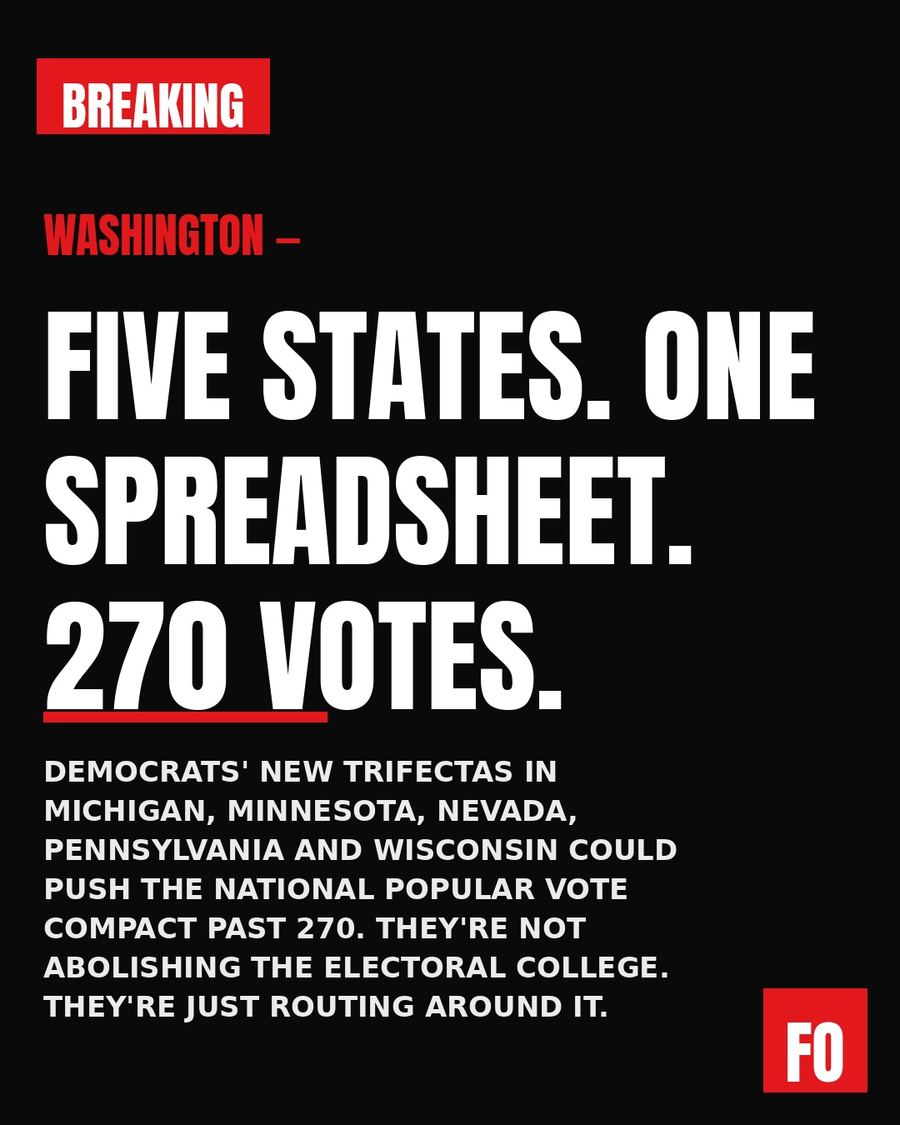
The Electoral College has survived two centuries of people trying to kill it, and the latest attempt doesn't even bother with the killing part. It just routes around it.
Democrats' midterm wins handed them control of five state governments — Michigan, Minnesota, Nevada, Pennsylvania and Wisconsin — and those five trifectas hold enough electoral votes, in theory, to push the National Popular Vote Interstate Compact past the 270 threshold. The compact is a long-discussed agreement between states: each member pledges its electoral votes to whichever candidate wins the national popular vote, not just whoever wins that state. Eighteen states and the District of Columbia have already signed on, pledging a combined 222 electoral votes. The bills only take effect once enough states join to reach 270 — the number needed to decide a presidential election. If all five new trifectas signed on, the total would clear it, and America could elect a president by popular vote as soon as 2028.
Nobody is abolishing anything. Abolishing the Electoral College takes a constitutional amendment, and nobody has the votes for that. The compact is the workaround: a spreadsheet agreement between state legislatures that produces a popular-vote presidency without touching the Constitution. Election law experts say it would face a raft of legal challenges, including whether it needs congressional approval — and getting past a Senate filibuster and a presidential veto is its own adventure. Michigan tried a version of the bill in 2023 and it failed. Nevada's Democratic governor vetoed one in 2019, arguing it could diminish smaller states. Whether the five states actually do it isn't yet clear.
But the math is now on the table, and the math is the whole story. The heist needs 270. They have a spreadsheet.
Like your satire sourced?
Get the Dispatch — the week's sharpest offenses, with receipts attached.
Sources: USA Today (Nov. 6, 2026).
The underlying reporting is filed in the Evidence Locker: USA Today (Nov. 6, 2026).