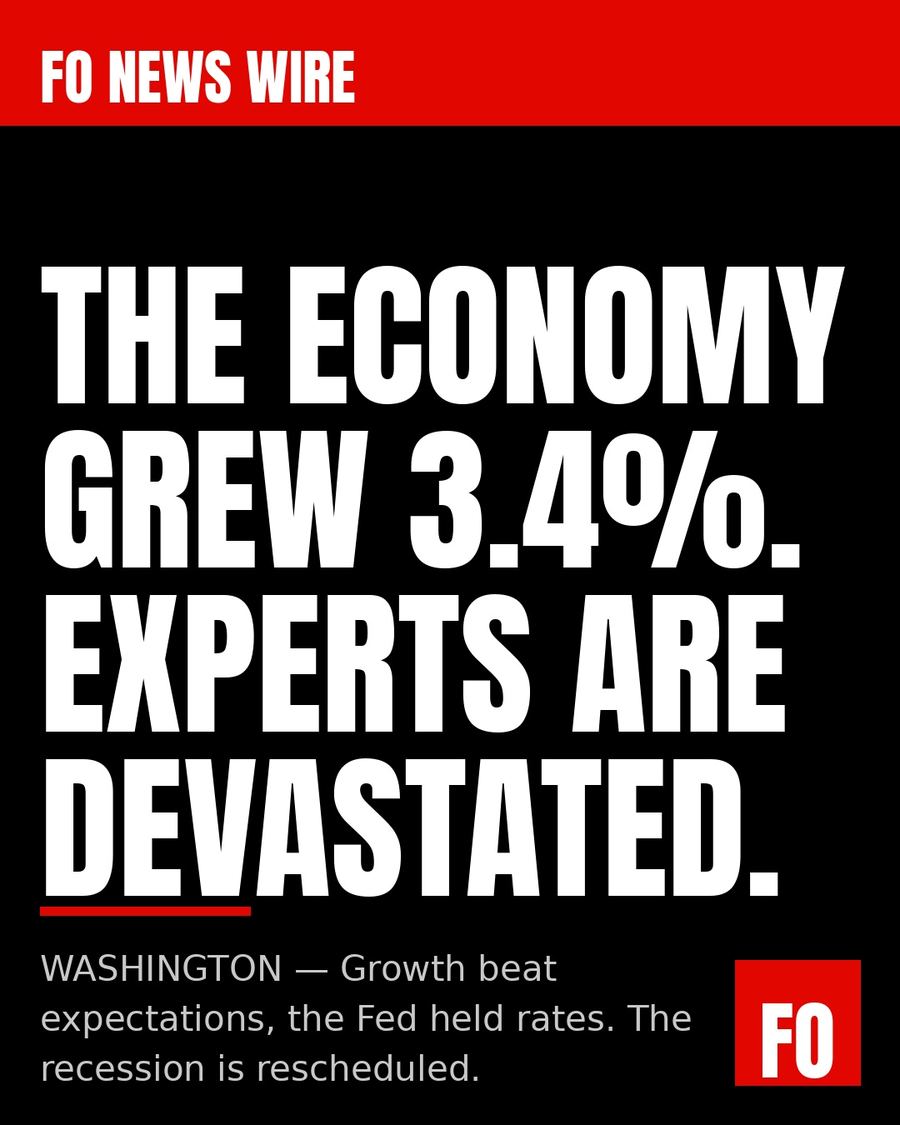
The economy grew 3.4 percent, and somewhere a professional predictor of doom quietly moved a calendar entry. The Bureau of Economic Analysis reported on October 29 that real GDP increased at an annual rate of 3.4 percent in the third quarter, up from 2.2 percent in the second, with investment, consumer spending, and government spending all contributing. The day before, the Federal Reserve held its target range at 3.75 to 4 percent.
This is the advance estimate, the first of three readings, and it will be revised on November 25. But the headline number is the headline number: growth accelerated, private domestic demand grew 4.9 percent, and the economy that was supposed to be collapsing posted one of its stronger quarters.
For the recession-prediction industry, this is a scheduling crisis. The downturn has been forecast so often, with such confidence, that its repeated failure to arrive now requires its own logistics department. Each strong report is filed under disappointments, and each postponement is announced with the solemnity of a weather delay.
The punch here is not the economy, which is doing fine by the government's own numbers, and not the Fed, which held rates by a 10 to 2 vote. It is the pundit class that stares at a growth number like a parking ticket and announces that the real recession is still coming, just later, definitely, trust them this time.
Like your satire sourced?
Get the Dispatch — the week's sharpest offenses, with receipts attached.
CORRECTION: the recession has been rescheduled to a later date. Attendees are advised to keep their forecasts warm and their credibility on ice.
The underlying reporting is filed in the Evidence Locker: U.S. Bureau of Economic Analysis (Oct. 29, 2026); Federal Reserve (Oct. 28, 2026).