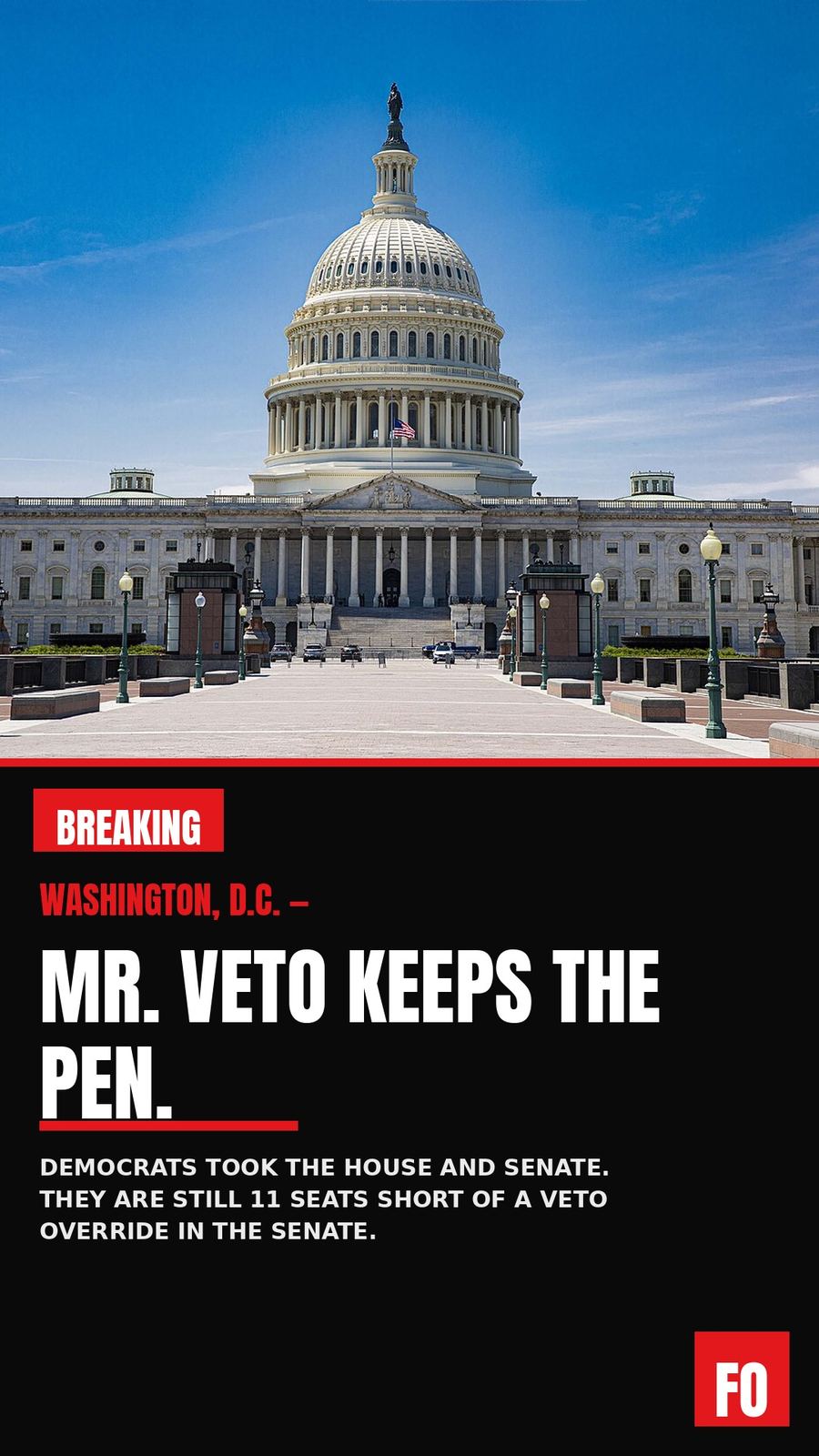
Democrats won the House. Democrats won the Senate. Democrats did not win the pen.
That is the arithmetic of Tuesday night, and it is the only part of the evening nobody is spinning. The new Democratic majorities are real, and so is the math underneath them: about 56 Senate seats is 11 short of the 67 needed to override a presidential veto, and close to 260 House seats is roughly 30 short of 290. A majority is a majority. A veto-proof majority is a different animal entirely, and nobody in Washington owns one.
Trump saw this coming and named it himself. He vowed to become "Mr. Veto" if Democrats took Congress and passed legislation he does not support, which is the most honest campaign promise of the cycle: a president with a veto pen and a Congress without two-thirds is a president who can say no forever. The phone and the pen are still in the Oval Office, and the Oval Office is not taking calls from the majority leader.
None of this makes the Democratic win meaningless. A House majority elects the speaker, runs the committees, and launches the investigations. A Senate majority blocks the nominees. The new Congress can make life extremely difficult for an administration, trim its travel budgets, and haul its officials into hearings until the chairs wear out. What it cannot do, on its own, is pass a bill over the president's signature. That takes Republicans crossing the aisle, and Republicans crossing the aisle takes a bill they actually want to pass.
Like your satire sourced?
Get the Dispatch — the week's sharpest offenses, with receipts attached.
So the next two years will look like this: Democrats passing bills they know will be vetoed, Trump vetoing bills he knows will be passed, and both sides holding press conferences about the other side's obstruction. The cartoon version of this story is a lame duck turning into Mr. Veto. The real version is slower, duller, and exactly the same: the majority governs the building, and the pen governs the outcome.
Sources: Reuters (Nov. 6, 2026); GrrrGraphics (Nov. 4, 2026).
The underlying reporting is filed in the Evidence Locker: Reuters (Nov. 6, 2026).