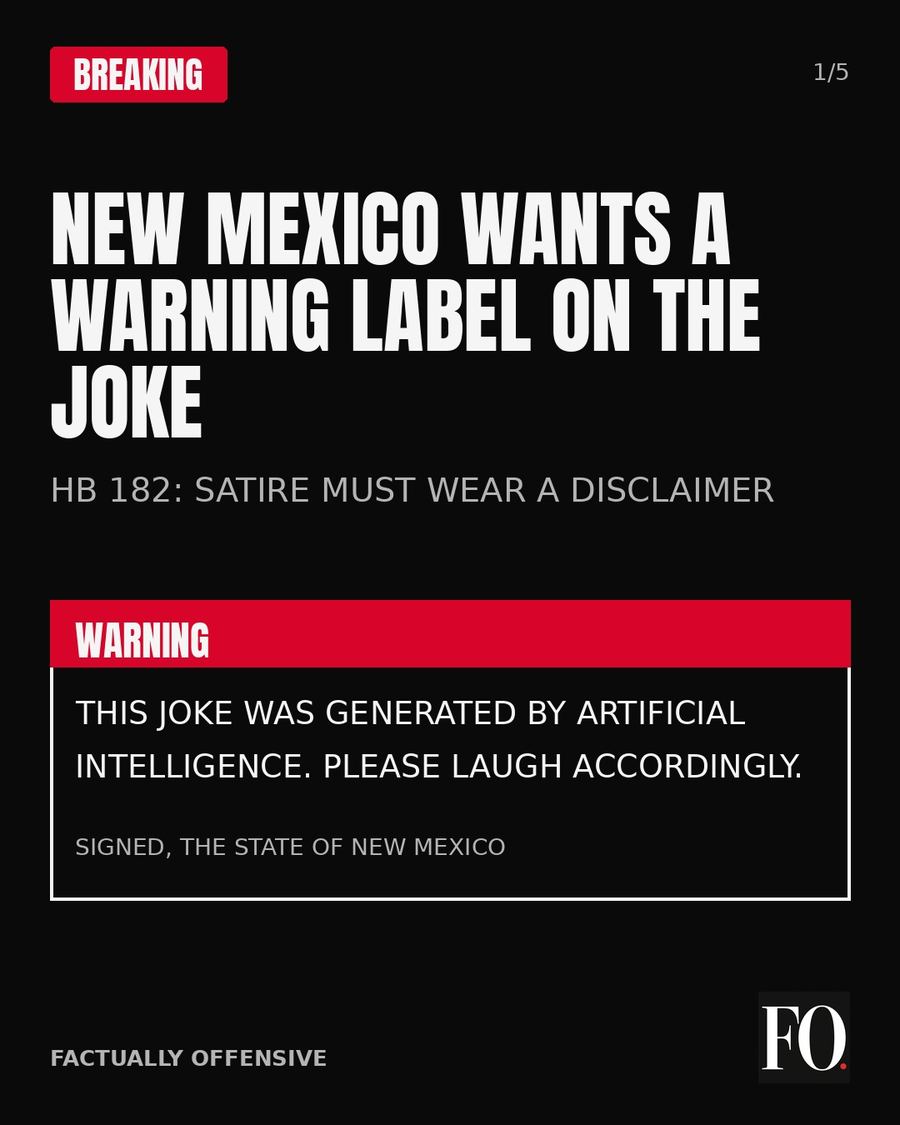
New Mexico did not ban satire. It did something dumber. It told satire to introduce itself first.
House Bill 182 passed in 2024 and amended the state's Campaign Reporting Act. The bill was sponsored by Rep. Gail Chasey, a Democrat from Albuquerque, and signed by Gov. Michelle Lujan Grisham. On paper it targets AI-generated political ads. In practice it reaches satire, parody, memes, flyers, and social media posts. Any covered ad with AI-made or AI-manipulated media must carry a prominent disclaimer saying it "has been manipulated or generated by artificial intelligence." Satire and parody get an exemption only if they carry that same disclaimer. The rule runs all year, not just near elections.
That is the whole joke, and the whole problem. A disclaimer that says "this is satire" before the punchline is not a label on the joke. It is the joke, defused. The Babylon Bee said exactly that when it sued in August 2026, represented by Alliance Defending Freedom. The complaint argues the label spoils the joke as it begins, every time, by alerting the viewer to the satirical nature of the communication and draining its rhetorical force. The Bee also argues the law is compelled speech: the state stuffing words into a speaker's mouth. CEO Seth Dillon put it plainly, saying New Mexico is forcing the Bee to say things it would not say otherwise.
Here is the part that should embarrass Santa Fe. Even New Mexico's own officials have blinked. Lujan Grisham flagged ambiguous language and potential legal issues when she signed the bill, and signed it anyway. In July 2025, Attorney General Raul Torrez issued an opinion concluding that applying the disclaimer requirement to satire and parody is likely unconstitutional on its face, because satire and parody by definition are not likely to mislead a reasonable viewer into believing they reflect actual facts. The State Ethics Commission says it has never enforced the AI-disclaimer rule against a satirist.
Like your satire sourced?
Get the Dispatch — the week's sharpest offenses, with receipts attached.
So the law sits there, unenforced and undefended, chilling speech by existing. The complaint notes fines of up to $20,000 for violators. Nobody has to be fined for the threat to work. A small satire outlet looks at that number and self-censors. A big one sues. That is the chilling effect in action, and it is why pre-enforcement lawsuits exist.
The Bee has run this play before and won. A federal judge struck down California's version of this kind of law, and a federal judge in Hawaii permanently blocked that state's deepfake statute in January 2026. New Mexico is next in line, and its own attorney general already told the legislature how this ends.
Free speech does not need a warning label. A joke that has to announce itself is not a joke anymore. It is a compliance form with a punchline attached. If the joke needs a warning label, the legislature is the punchline.
See the original post on Instagram. Full sourcing lives in the Evidence Locker.