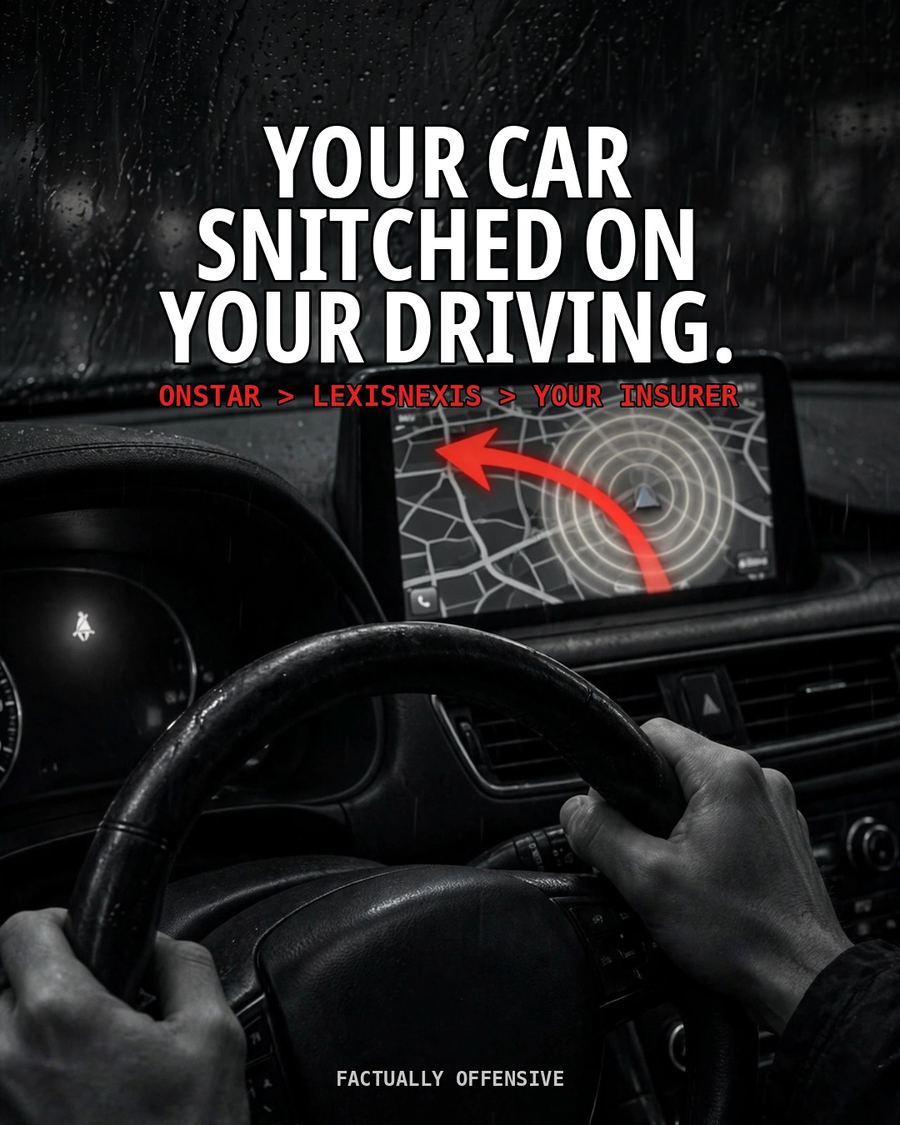
Your car talks. Specifically, it talks about you — to people you never introduced it to.
General Motors' OnStar Smart Driver quietly recorded how fast you drove, how hard you braked, and whether you were out driving late at night. Then it sold the whole diary to data brokers LexisNexis and Verisk, who repackaged it and sold it to insurance companies. Drivers only found out when their premiums went up — the automotive equivalent of learning your journal has a publisher.
LexisNexis and Verisk deserve their own paragraph, because they are the least famous companies doing the most famous thing. You have never bought anything from them. You have never signed up for them. They simply purchased a copy of your driving from the company that sold you the car, and sold it to the company that insures the car. It is a supply chain, and you are the raw material.
The comedy here is structural. You bought a car. The car picked up a surveillance habit. And the bill for the habit came to you, itemized as a higher premium. Nobody asked. Nobody signed anything. The data just left the vehicle the way your teenager leaves the house — quietly, and with your wallet involved.
Like your satire sourced?
Get the Dispatch — the week's sharpest offenses, with receipts attached.
Eventually the Federal Trade Commission noticed. In January 2026 it banned GM from sharing driver data with consumer reporting agencies for five years. Five years. The corporate equivalent of being grounded — a punishment calibrated so precisely it almost reads as a pricing schedule. Somewhere a compliance officer framed it.
The real joke is the business model. Your braking habits are worth money to someone, just not to you. The data economy runs on this exact asymmetry: everyone profits from your life except the person living it. Your car, at least, was honest about what it wanted to be. It wanted to be a reporter. Drive accordingly. Or don't — it's already been filed.
See the original post on Instagram. More from this story is filed in the Evidence Locker.