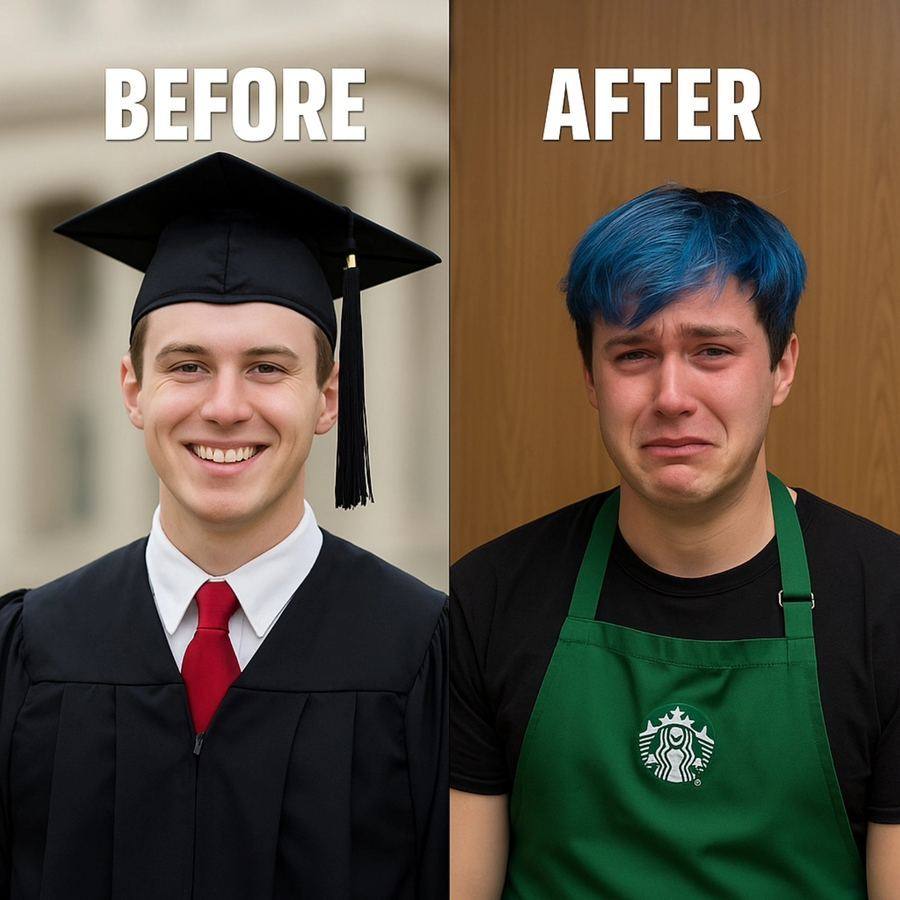
The receipt is simple, and that is the problem. Two years at the average cost of college, and you can forget common sense entirely — for only $80,000.
The Education Data Initiative puts the average cost of college in the United States at $39,406 per student per year, including books, supplies, and daily living expenses, for the 2023-24 academic year. At a private nonprofit university, an on-campus student paid $60,924 in that same year. Two years at the average works out to $78,812, which rounds, with fees and a straight face, to $80,000. That is the price of admission to the forgetting.
What, exactly, gets forgotten? Start with the job market. A June 2026 study from the Federal Reserve Bank of New York, reported by TheStreet, found that remote work explains 64% of the increase in unemployment among young college graduates — from 3.1% in 2017–19 to 3.7% in 2022–25. The mechanism is almost too on-the-nose: junior staff in remote roles miss the desk-side feedback, shadowing, and informal coaching that build early-career skills, leaving managers less willing to bet on candidates who need hands-on training. The degree taught them everything except the thing the office used to teach for free — how to be around other people, learning, in person.
So the pipeline now works like this. Pay $39,406 a year to learn from professors. Graduate into a remote job market that will not teach you the rest, because remote work removed the desk you would have learned beside. Discover that the unemployment rate for your cohort rose while you were paying for the privilege. And somewhere along the way, forget the common sense that would have told you to ask, before enrolling, whether the most expensive thing you will ever buy should come with a chair in a room where someone older shows you how it is done.
Like your satire sourced?
Get the Dispatch — the week's sharpest offenses, with receipts attached.
Common sense, it turns out, is the one subject with no tuition. It is also the first thing the system un-teaches, at $39,406 a year, two years running, until the total hits $80,000 and the graduate emerges fully credentialed and completely unprepared for the office that no longer exists.
The good news: common sense is free, it is not offered for credit, and it cannot be taken away by a bursar. The bad news: nobody is selling it, which in this economy means nobody is buying it either.
The underlying reporting is filed in the Evidence Locker: Education Data Initiative (2026); TheStreet, reporting the Federal Reserve Bank of New York study (June 3, 2026).