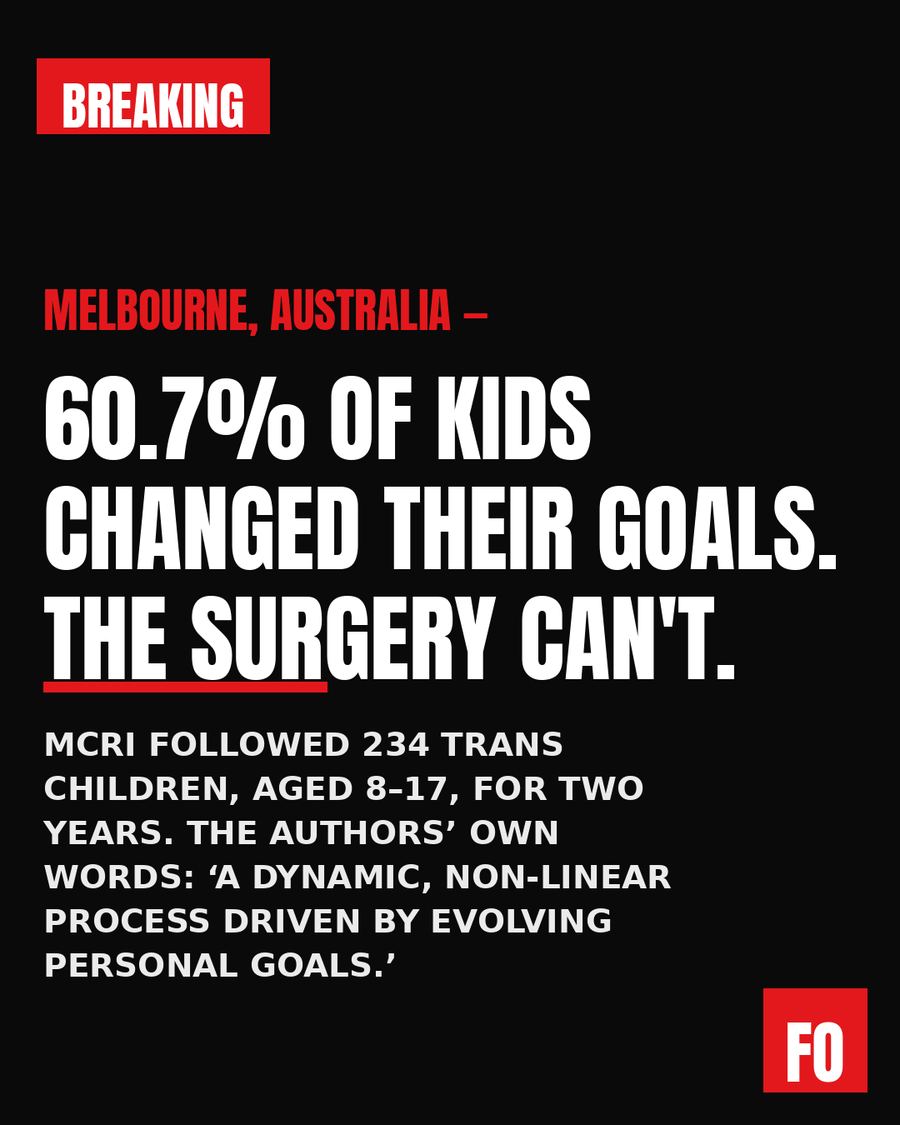
The researchers have published their own punchline. Melbourne's Murdoch Children's Research Institute followed 234 trans children, aged 8 to 17, for up to two years to see how their social transition goals — names, pronouns, appearance — changed over time. The finding, published in The Lancet Regional Health – Western Pacific: 60.7% of the young people adjusted their goals during the study. And the authors' interpretation, in their own words, is that social transition is "a dynamic, non-linear process driven by evolving personal goals."
Translation for the non-clinicians: the kids kept changing what they wanted. The study's own numbers say most of them did it.
A companion MCRI-led paper, this one in JAMA Pediatrics, adds the other half of the picture. Among young people presenting to a specialist pediatric gender service, the share identifying as nonbinary rose from 14.2% in 2017 to 39% in 2023 — a 2.7-fold jump. The patient population is not only changing its goals; it is itself changing.
Like your satire sourced?
Get the Dispatch — the week's sharpest offenses, with receipts attached.
None of this would be particularly funny if the interventions built on top of those goals were as dynamic and non-linear as the authors describe. They are not. And that is the entire joke — pre-written, by the researchers themselves.
The underlying reporting is filed in the Evidence Locker: The Lancet Regional Health – Western Pacific (2026); JAMA Pediatrics (2026-10-12); Murdoch Children's Research Institute (2026-10-20).