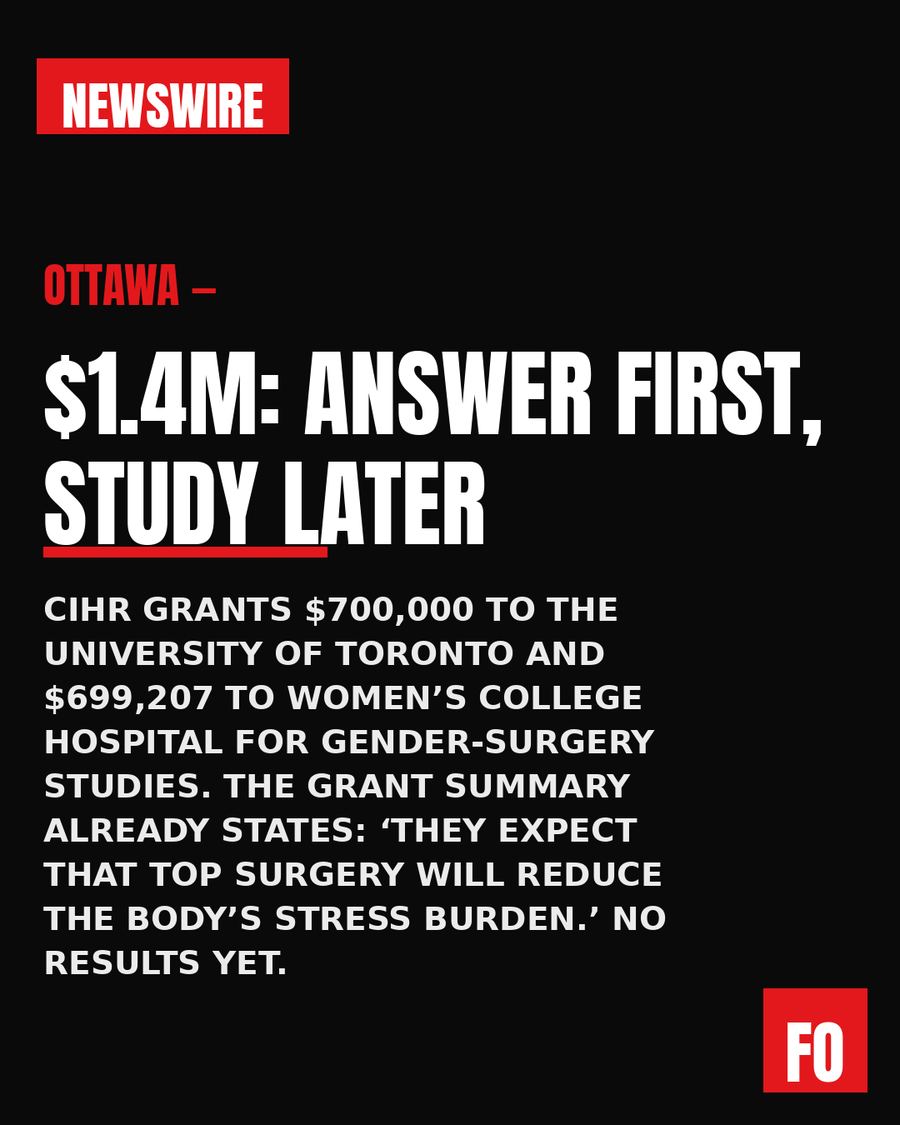
Science has a new workflow, and it is wonderfully efficient: decide what the study will find, write the finding into the grant application, collect the cheque, and then — in a few years — collect the data. Ottawa just funded the pilot program.
The Canadian Institutes of Health Research, the federal agency that funds health research, awarded two four-year grants out of its "Advancing 2S/LGBTQI+ Health Through Research" competition. Grant one: $700,000, paid to the University of Toronto, for "Gender-Affirming Chest Surgery and Allostatic Load in Transgender Men and Non-Binary Individuals," a prospective study of how chest surgery relates to allostatic load — the cumulative physiological effects of prolonged stress on the body. Grant two: $699,207, paid to Women's College Hospital in Toronto, for implementing a digital patient-reported outcomes questionnaire into its gender-surgery care pathways. Combined total: $1,399,207. Call it $1.4 million and keep the change.
The comedy is in the paperwork. The chest-surgery study's official CIHR grant summary — the federal record, written by the researchers themselves — states the expected outcome as a flat fact of the plan: "They expect that top surgery will reduce the body's stress burden, and that improved body satisfaction is the key reason why this happens." The same summary notes, as settled knowledge, that "we know that top surgery improves mental health," and closes with the payoff the evidence is expected to deliver: it "could strengthen support for access to gender-affirming care." No results have been published yet — the studies are described prospectively throughout the hospital's own announcement — but the hoped-for conclusion is already in the application.
To be fair, every grant application has a hypothesis. A hypothesis says "we suspect X and will test it." This one says, in the federal record, that the researchers expect X, that X is the reason why the result will happen, and that the evidence will support the policy position they already hold. That is not a hypothesis. That is a press release with a grant number.
Like your satire sourced?
Get the Dispatch — the week's sharpest offenses, with receipts attached.
Nobody is against research. The whole point of spending $1.4 million is to find out something you do not already know. But a four-year study that announces its conclusion before its first blood test is not discovering anything — it is confirming something, on a schedule, at public expense. The scientific method called; it would like its job back.
The underlying reporting is filed in the Evidence Locker: CIHR Funding Decisions Database, grant records (2026-10-22); Women's College Hospital (2026-10); Canadian Healthcare Technology (2026-10-21). The expected-outcome language quoted above comes from the grant summary itself.
The grant records state no age range; nothing here claims these grants involve minors.