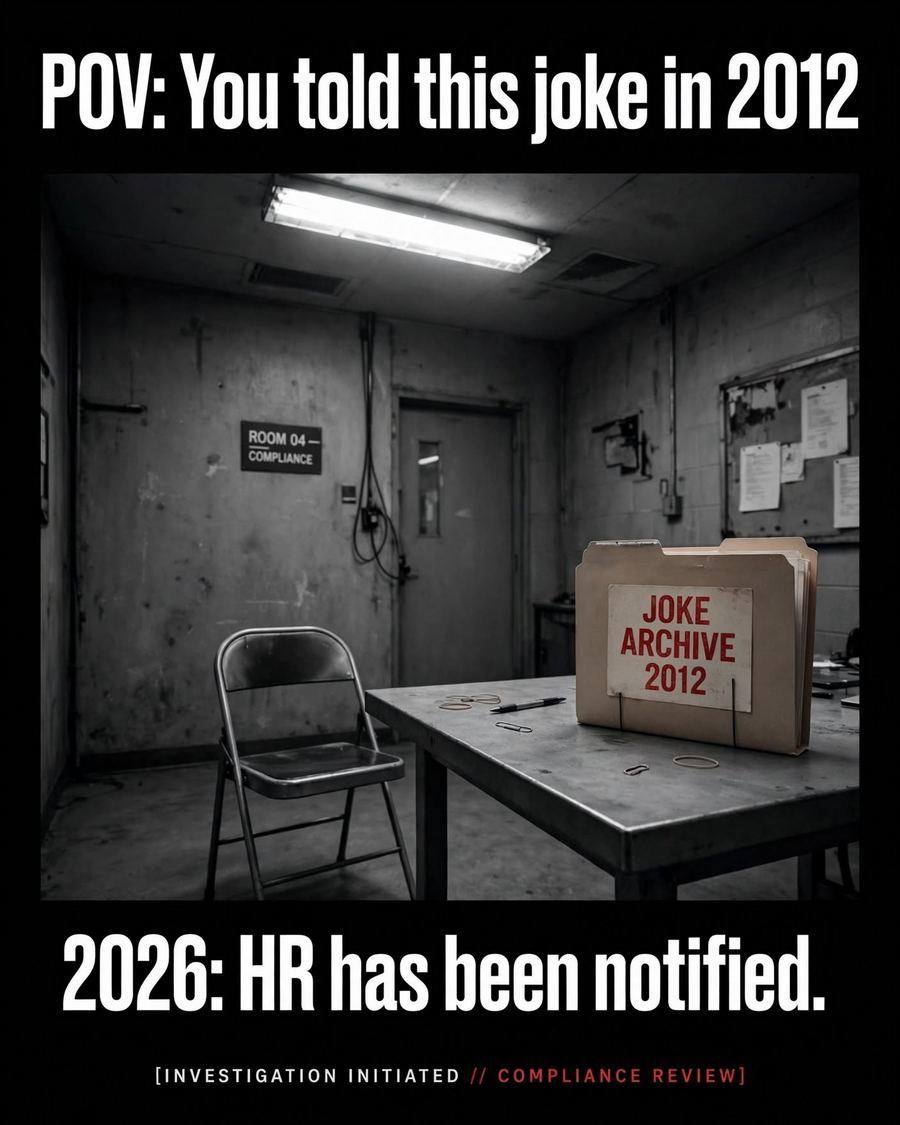
The joke is exactly the same as it was ten years ago. What changed is that you now need a permission slip to tell it.
In June 2025, Phys.org republished a political scientist's account of a 2022 survey of a representative sample of about 1,500 U.S. residents. The numbers are blunt: 45% of respondents were worried about expressing their views to members of their immediate family, and that figure ballooned to 62% when it came to speaking out publicly in one's own community. Nearly half said they felt less free to speak their minds than they used to. And about three to four times more Americans said they did not feel free to express themselves, compared with the number who said so during the McCarthy era.
The McCarthy era. The one with actual blacklists. Americans now report feeling less free to speak than people did when careers ended over accusations.
The mechanism has a name, coined in the 1970s by German political scientist Elisabeth Noelle-Neumann: the "spiral of silence." Someone expresses a view, encounters vigorous criticism from an aggressive minority, and learns that the costs of speaking — criticism, personal attacks, ended friendships, uninvited Thanksgivings — are simply too high. So they go quiet. Their views then appear less common than they are, which makes the next person quieter still, until the loudest minority looks like the majority and the majority looks like it never existed.
Like your satire sourced?
Get the Dispatch — the week's sharpest offenses, with receipts attached.
This is the part where the joke comes in. The joke did not get more offensive. It did not get less true. It got a compliance department. Telling it now requires checking the room, checking the audience, checking whether anyone present has the authority to be offended on behalf of someone else, and then — if all clearances come through — telling it more quietly than you would have a decade ago, to fewer people, with a disclaimer attached.
The permission slip, it turns out, is the whole bit. Nobody banned the joke. They just made it exhausting to tell. And exhaustion, unlike censorship, does not leave a paper trail. It leaves a silence that sounds, to everyone listening, exactly like agreement.
The underlying reporting is filed in the Evidence Locker: Phys.org / The Conversation (June 26, 2025).