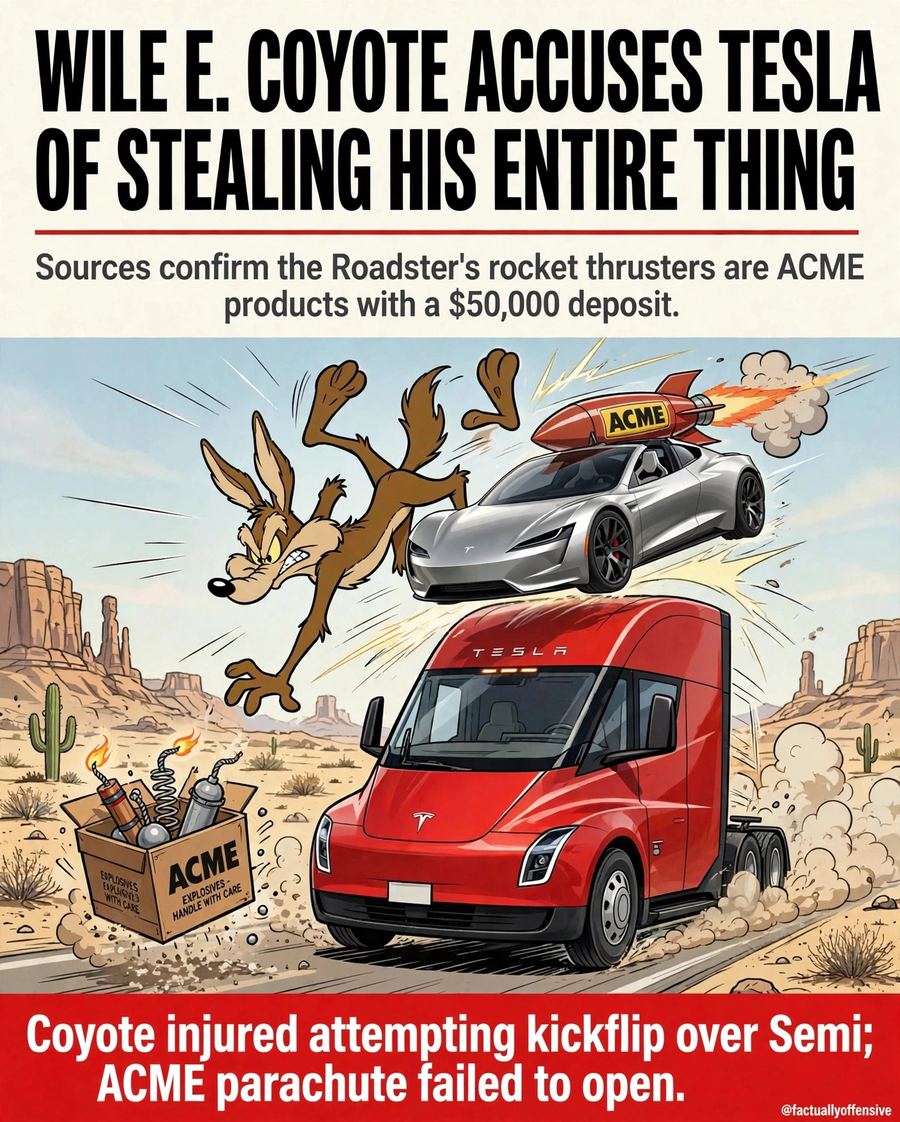
The complaint arrived, as these things do, after the demonstration. Tesla had just shown the world its new Roadster doing things cars are not supposed to do, and somewhere in the desert, a coyote recognized his entire life's work.
On October 15, 2026, Tesla unveiled the long-delayed second-generation Roadster at a SpaceX test facility near Waco, Texas. Bloomberg reported that the prototype, powered by air thrusters developed with SpaceX engineers, drove up a ramp, did a controlled flip, and then jumped and flipped over Tesla's vehicle lineup — including the Semi. TechCrunch added the full roster for the stunt the company calls a "kick flip": a Cybercab, a Cybertruck, a Semi, a Model Y, and a Model 3, all cleared while in motion.
The machine itself reads like a catalog order gone wrong in the best way. Ten cold-gas thrusters fed by 600 liters of compressed air, stored in carbon-fiber overwrapped pressure vessels packed into "every usable void" of the car. Three trims: Performance, road-ready, with a $50,000 reservation; Thrust, race-ready, at $250,000; and Rocket, single-seat, invite-only, and — in Tesla's own words — not approved for public roads. Range is listed at more than 300 miles, top speed above 230 mph, and production is targeted for 2028.
This is where the coyote's grievance gets interesting. The Roadster was first promised in 2017 with a 0-60 time of 1.9 seconds, 620 miles of range, four seats, a $200,000 price, and deliveries in 2020. Fast Company notes what showed up instead: a two-seater with "over 300 miles" of range, no price at all, and a 2028 date. Nine years of delays, and the car finally arrives by doing exactly what a cartoon coyote has always done — strapping rockets to something and seeing what happens.
Like your satire sourced?
Get the Dispatch — the week's sharpest offenses, with receipts attached.
The difference, the complaint alleges, is that the coyote's devices always backfired, while Tesla's demo actually worked. The prototype flipped, flew, and landed. Nobody was inside, because as Musk has put it, safety is not the main goal here, and the company would merely "aspire not to kill anyone in this car." The coyote, who has survived considerably worse with considerably less funding, considers this a personal insult.
Tesla, for its part, has not responded to the complaint, possibly because it is busy deciding whether the Roadster is a car, an aircraft, or a cry for help. The Federal Aviation Administration, asked about a machine that leaves the surface of the earth, would presumably have questions of its own.
The coyote's case rests on one unassailable point: he did it first, he did it cheaper, and his version never required a reservation deposit. Tesla's version does flips. His version did pratfalls. The court of public opinion will decide which one counts as innovation.
The underlying reporting is filed in the Evidence Locker: Moneyweb (Bloomberg) (Oct 16, 2026); TechCrunch (Oct 15, 2026); EV Central (Oct 16, 2026); Fast Company (Oct 16, 2026).