The pollsters had one job, and they gave the lead to the wrong guy.
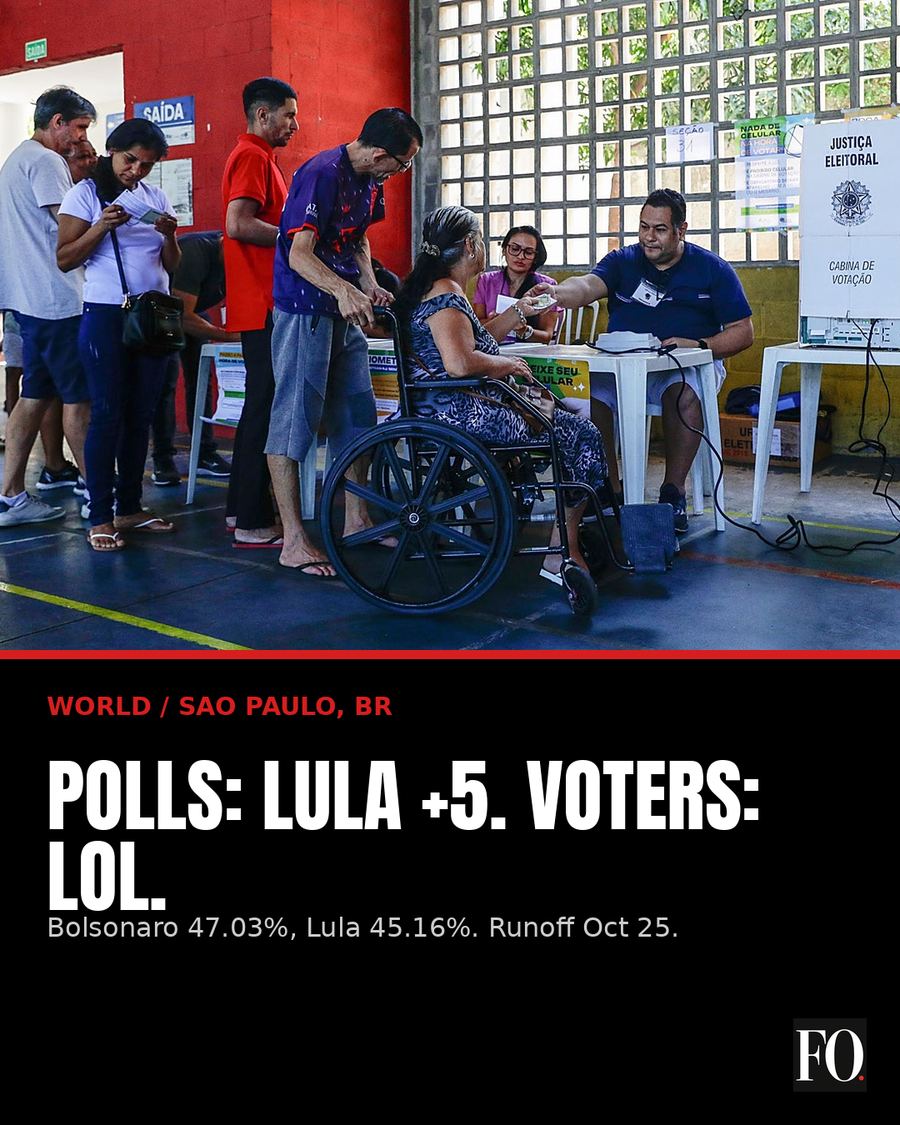
Brazil's presidential first round, held October 4, ended with Senator Flavio Bolsonaro of the right-wing Liberal Party at 47.03 percent of valid votes against 45.16 percent for incumbent President Luiz Inacio Lula da Silva. That's roughly 2.2 million votes, 56.1 million to 53.9 million, the closest first-round result since Brazil returned to direct presidential elections, and the smallest gap between the top two finishers in a first round since 1989. Neither cleared 50 percent, so they meet again in a runoff on October 25.
Now the polls. A Datafolha survey published days before the election gave Lula 45 percent of valid votes and Bolsonaro 40 percent. Two weeks earlier it had been Lula 40, Bolsonaro 36 in total voting intentions. The pollsters saw the trend moving toward Bolsonaro and still handed Lula a five-point lead in the final call. The voters handed the lead to Bolsonaro by nearly two points. That's a seven-point swing between the final poll and the ballot box, in an election with mandatory voting and electronic ballot boxes that count fast. There is no "late deciders" fog to hide in. The electorate simply wasn't where the pollsters said it was.
The aftermath has been its own comedy. Third-place finisher Augusto Cury, the author-psychiatrist who took 2.89 percent, endorsed Bolsonaro for the runoff. Ronaldo Caiado endorsed Bolsonaro earlier in the week. A post-first-round Datafolha runoff simulation showed Bolsonaro at 49 percent to Lula's 45, technically a tie within the margin of error, but the direction of travel is unmistakable. No first-round runner-up has overturned a deficit in the second round since democracy returned to Brazil in 1985, which puts Lula in the position of needing to make history just to keep his job.
Like your satire sourced?
Get the Dispatch — the week's sharpest offenses, with receipts attached.
The meme's game is the polling industry's latest self-inflicted L, and it's a rich tradition. Polls are a model of what people say to strangers on the phone, weighted by assumptions about who will show up. Elections are a count of who actually showed up. Every few years the gap between those two things becomes a punchline, and the pollsters respond the way they always do: by adjusting the model, publishing a methodology note, and getting the next one wrong in a new and interesting way.
To be fair to the pollsters, they did catch the momentum. They just couldn't bring themselves to believe it. There's a lesson in there about the difference between measuring a trend and trusting it. The voters trusted it. The voters were right.
The receipts, on file in the Evidence Locker:
- Brazil's first round: Flavio Bolsonaro 47.03% (56.1M votes) vs. Lula 45.16% (53.9M); runoff set for October 25; closest first round since 1989. (Latin America Reports) - Final Datafolha poll had Lula at 45% and Bolsonaro at 40% of valid votes; post-first-round runoff poll showed Bolsonaro 49, Lula 45. (Latin America Reports; Reuters, October 8, 2026)
See the original post on Instagram. Full sourcing lives in the Evidence Locker.