Every bad roommate story has the same structure. One person uses all the hot water, eats the leftovers, and somehow never sees the utility bill. Now scale that up to the size of a small city, give it a stock ticker, and you've got the American data-center boom.
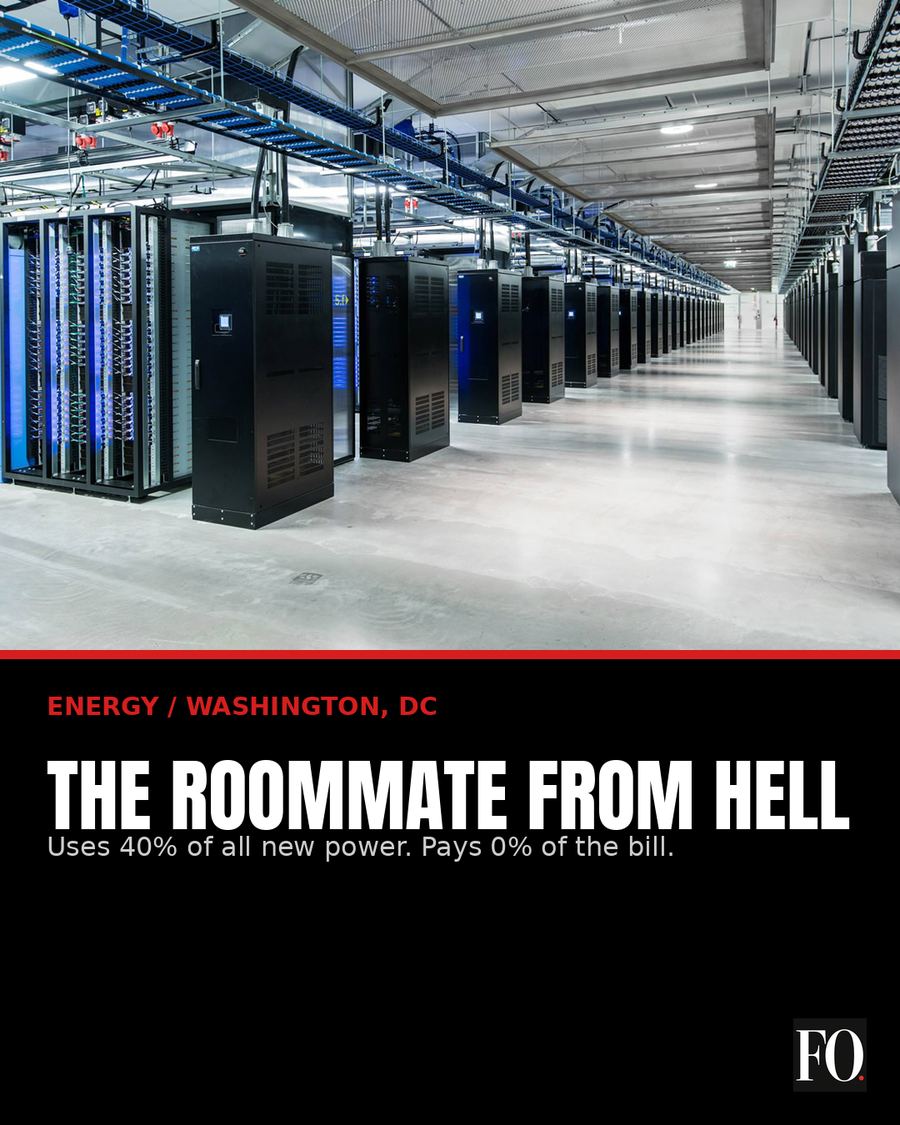
Here's the math. Goldman Sachs projects that data centers will represent 40 percent of all new U.S. electricity demand growth through 2027, in a February report covered by CNBC. U.S. electricity prices rose 6.9 percent in 2025, more than double general inflation, and the bank expects another 6 percent a year through 2027. The Energy Institute's 2026 Statistical Review found American data centers consumed 312.6 terawatt-hours in 2025, nearly 40 percent of the entire planet's data-center electricity. The cloud, it turns out, is a power plant with a marketing department.
So Congress tried to do something about the bill. The Ratepayer Protection Act, sponsored by Senator Jon Husted of Ohio, was a modest proposal: require states to consider a federal standard making large-load customers, data centers with peak demand of at least 100 megawatts at a single site, cover the full cost of the grid upgrades built to serve them, with financial assurances up front. The House passed it 417 to 3. Alexandria Ocasio-Cortez voted for it. Nancy Pelosi voted for it. Hakeem Jeffries voted for it. It was the closest thing to a consensus Washington has produced in years.
Then it reached the Senate. On September 30, the motion to advance failed 57 to 43, three votes short of the 60 needed. Every single no vote came from Democrats or independents. Four Democrats crossed over to vote yes. Democratic leadership called the bill "a fraud" and "a suggestion," arguing it didn't go far enough, which is a curious standard to apply to a bill your own House members passed nearly unanimously two weeks earlier. Republicans, not entirely innocently, noted the timing: Husted is in a tough special-election fight against Sherrod Brown, who has been running ads calling Husted "the face of data centers."
Like your satire sourced?
Get the Dispatch — the week's sharpest offenses, with receipts attached.
The game of the meme is the roommate, and the roommate is the data center: uses 40 percent of all new power, pays zero percent of the bill. The punch is that the bill-splitting conversation happened, in public, on the Senate floor, and the roommates' friends voted to keep the arrangement. Rent's going up. His isn't.
The receipts, on file in the Evidence Locker:
- Goldman Sachs projects data centers will represent 40 percent of U.S. electricity demand growth through 2027; electricity prices rose 6.9 percent in 2025. (WebProNews, citing CNBC) - The Senate failed to advance the Ratepayer Protection Act 57-43 on September 30, 2026, short of the 60 votes needed; it had passed the House 417-3 and targeted data centers with 100+ megawatts of peak demand. (Digital Watch Observatory, October 1, 2026)
See the original post on Instagram. Full sourcing lives in the Evidence Locker.