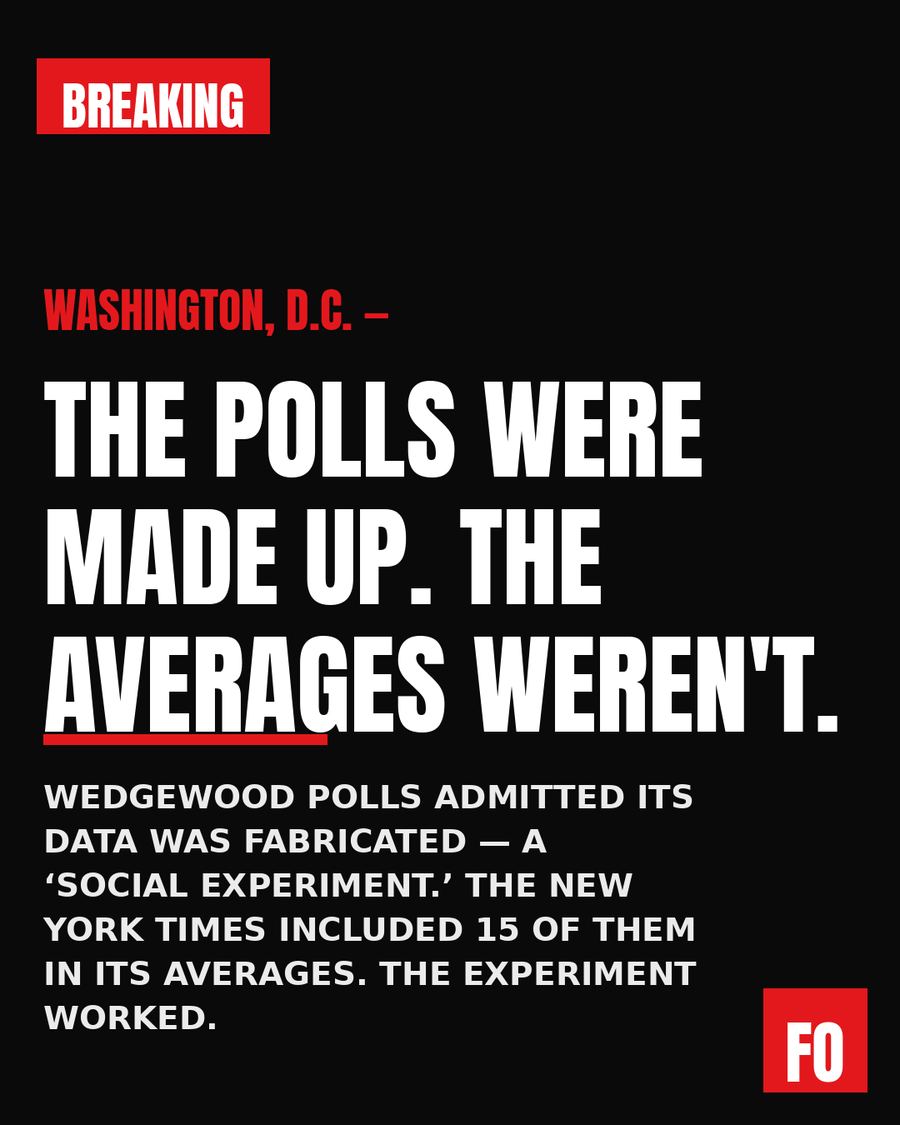
An outfit calling itself Wedgewood Polls released a statement on Tuesday admitting that its polling data across several congressional and gubernatorial races this cycle was entirely fabricated. It called the months of invented numbers a "social experiment." The hypothesis, in the firm's own words: "How easy is it for an entirely fabricated polling firm to gain traction, be taken seriously, and expose how little scrutinization exists in media and public commentary?" The short answer, apparently: far too easy.
Wedgewood had been pumping out fake results since June on high-stakes races in Georgia, Michigan, Texas and other states. The numbers found their way into news articles and the polling compilations readers use to judge where candidates stand. USA Today cited the group in its reporting and has since attached editor's notes and removed the references. The New York Times said it had to pull 15 Wedgewood polls released between June and October from its compilations. The fake firm even collected money from donors, crowdfunding its purported research — FiftyPlusOne, the polling analysis site, is what finally unraveled it, paying to recreate a recent Wedgewood poll and finding the underlying respondent data didn't behave the way real survey data does.
The falsified data consistently favored Democrats, and at least two of them campaigned off it. In Mississippi, Senate nominee Scott Colom touted a Newsweek piece built on an Oct. 14 Wedgewood survey showing him within striking distance of Sen. Cindy Hyde-Smith; the Senate Majority PAC invested $1.2 million in the race days later (the DSCC denies making decisions off external polling). In Michigan, nominee Abdul el Sayed used a June 28 Wedgewood poll showing him the only Democrat leading Republican Mike Rogers in a July 3 fundraising email. In Wisconsin, Wedgewood's numbers showed Francesca Hong leading the Democratic gubernatorial field; she lost the primary to David Crowley by less than a point.
And then there is the wreckage. A Wedgewood survey in late June showed Michigan state Sen. Mallory McMorrow at just 9% in the Democratic Senate primary. She says donations dried up, her volunteers panicked, and the press started calling to ask when she'd drop out. She withdrew on July 5 — before anyone knew the numbers were fiction. A Democrat destroyed by a "social experiment" nobody was told they were in.
Like your satire sourced?
Get the Dispatch — the week's sharpest offenses, with receipts attached.
Wedgewood's website and email are now dead. USA Today couldn't reach anyone behind it. The firm claims it conducted one real poll, in Nebraska — everything else was the experiment. The polling industry is now having its postmortem, and the aggregators have scrubbed their averages. But the lesson isn't that the averages were wrong for a few months. The lesson is that a nonexistent firm invented numbers for four months, and the entire apparatus — media, aggregators, campaigns, donors — treated fiction as data until a poll-tracking site paid to re-run a survey and noticed the transaction IDs were fake.
The polls were made up. The averages weren't. The damage is real.
The underlying reporting is filed in the Evidence Locker: Washington Examiner (Oct. 2026); USA Today (Oct. 21, 2026).